September Market Wrap – Lonely Winners
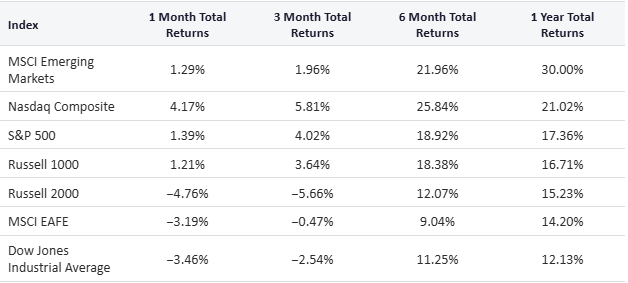
September finally reminded everyone that markets don’t only go up. The Nasdaq Composite was the only major index we track to finish green, up 1.93%, and nearly everything else gave ground — the S&P 500 slipped 0.35%, emerging markets lost 0.50%, the Russell 1000 fell 0.65%, developed international (MSCI EAFE) gave back 3.01%, the Dow dropped 4.12%, and the Russell 2000 took the worst of it at −5.25%. After an August where you didn’t have to be clever, September made you earn it.
Under the hood, this was a market of lonely winners. Technology was the only sector to finish positive, up 5.1%, while Financials and Materials each fell more than 7%. Energy — the undisputed leader over the last twelve months, up 41.6% — gave back 3.3%, and large-cap growth was the only style box that made money. That is the mirror image of August’s broadening story: the equal-weight trade we were cheering a month ago stalled out, and the mega-cap tech names went right back to carrying the index on their shoulders.
The breadth numbers are where it gets uncomfortable. Right now, 305 of the S&P 500’s 504 constituents are now sitting in drawdowns of 20% or more — roughly 60% of the index — and 182 of them are more than 35% off their highs. Only 135 companies are up 20% or more this year. In other words, the index’s respectable year-to-date gain is being delivered by a small handful of names while the average stock is quietly in a bear market of its own. Add a Fed rate hike on the 16th, a 10-year Treasury yield at levels not seen since 2002, Brent crude up 25% on the month, and an AI-safety debate that knocked semiconductors 5% in a single session, and you had what felt like a year’s worth of headlines crammed into thirty days.
From a tape perspective, the month was a slow grind lower punctuated by one sharp rally. Indices drifted through the first two weeks, washed out right around the Fed decision, bounced hard into the 22nd as the Nasdaq briefly ran more than 3% for the month, and then faded into quarter-end as yields kept climbing. The first week of October has been kinder — the S&P 500 posted its first-ever close above 7,800 on the 5th on tech strength and a pause in the bond selloff — but the index has been choppy around that level ever since, with every uptick in yields pulling it back.
Fixed Income & Treasury Yields
This was the month the bond market stopped being background noise. The 10-year Treasury jumped 54 basis points to finish September at 5.29% — and traded as high as roughly 5.37% intraday, its highest level since April 2002. The belly took the biggest hit, with the 3-year and 5-year each up 60 basis points, while even the 1-month bill rose 17 basis points to cross 4% for the first time in a while. The 20- and 30-year finished at 5.68% and 5.64%. Credit didn’t escape either: the iShares iBoxx $ High Yield Corporate Bond ETF (HYG) fell 2.7%, and the 30-year mortgage rate pushed back above 7% for the first time since January 2025.
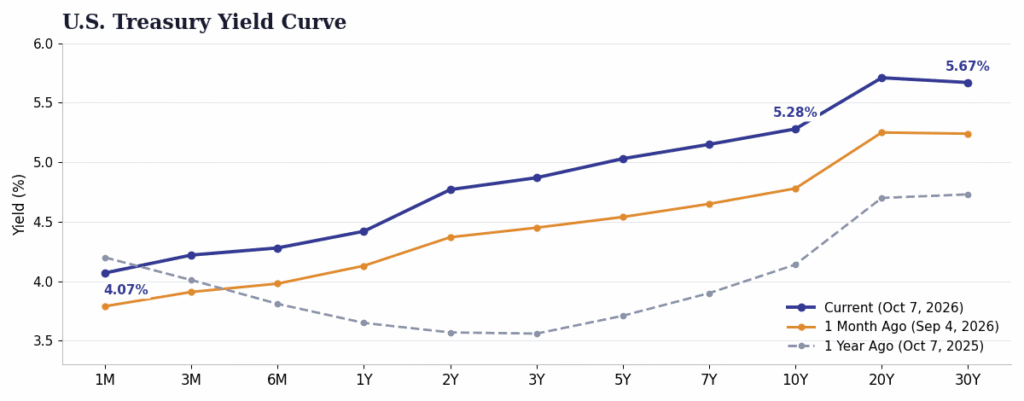
Put the current curve next to a year ago and the regime change is hard to miss. The front end is roughly where it was — the 1-month is actually a touch lower — but the 10-year is about 115 basis points higher and the long end is up more than 90. The inverted, U-shaped curve of October 2025 is now a clean, steep upward slope. Some of that is the Fed going back on offense, but most of it is term premium: investors are demanding to be paid for inflation risk, deficit risk, and an oil shock that hasn’t gone away. Yields have backed off a few basis points in the first week of October, which is exactly why stocks got their footing — the equity market is taking its cues from the 10-year right now, full stop.
Macro & Commodity Update
The Fed raised rates by 25 basis points on September 16th — its first hike since 2023 — taking the target range to 3.75%–4.00%. The vote was unanimous, and the minutes released this week show most participants think another increase will likely be appropriate by year-end. The labor data, though, is moving the other way. September payrolls, released on October 2nd, came in at just +29,000 against expectations in the 84,000–90,000 range; the unemployment rate ticked up to 4.2%; prior months were revised down a combined 60,000; and average hourly earnings rose only 0.1% on the month, putting annual wage growth at 3.0%, the slowest since 2021. Part of the rise in unemployment came from participation climbing to 61.8%, so this is more “low hire, low fire” than outright cracking — but it is not the labor market you hike into twice.
Inflation is the reason the Fed went anyway. August CPI held at 3.4% year over year, a touch cooler than feared, and core eased to 2.4%. The problem is what’s underneath: producer prices ran 5.4% year over year in August and the oil shock hasn’t fully flowed through to consumers yet. Elsewhere the economy is holding up better than the headlines — retail sales grew 1.24% in August, ISM Manufacturing sits at a healthy 54.6, and Services came in at 55.4. Housing is the clear casualty of higher rates: existing home sales fell 1.97% and the median price slipped to $429,100, with the 15-year mortgage at 6.42% and the 30-year at 7.03%.
Commodities flipped the script from August. Oil was the story — Brent crude surged 25% to $119.97 as the U.S.–Iran conflict continued to choke tanker traffic through the Strait of Hormuz, and WTI rose 8.62% to $99.37. Brent has since pulled back toward $100 in early October as flows through Hormuz recover, but they are still running roughly 23% below pre-war levels, and the pain at the pump is real: the national average for gas rose 9.41% to $4.60 a gallon. Precious metals gave back a chunk of August’s run, with GLD down 6.75% to $380.84 and SLV down 9.35% to $54.51 — though gold has started to firm again above $4,150 as yields cooled this week.
Crypto quietly had a good month. Bitcoin rose 7.7% to $83,640 and Ethereum jumped 10.81% to $2,677, inching both back toward breakeven on the year.
Market Outlook – Earnings vs. the 10-Year
October hands us two big tests in quick succession. The first is September CPI on the 14th, with consensus looking for headline to re-accelerate to the 3.6%–3.7% range as gasoline flows through. The second is the October 28th FOMC. After the soft jobs report, CME FedWatch has swung to roughly 78%–83% odds that the Fed holds — down from near coin-flip territory a week earlier — but the minutes make clear another hike is still on the table for December. A hot CPI print would put October back in play; an in-line one probably buys the market a pause.
The offset is earnings, and they are genuinely strong. FactSet has Q3 S&P 500 earnings growth tracking at about 29.5% year over year, with estimates actually rising during the quarter — rare — and 62% of companies issuing guidance have guided higher, well above the five-year average. Energy leads, followed by tech and communication services, and no sector is expected to post a decline. Banks kick things off on the 13th and 14th, corporate buyback windows reopen around mid-month, and the mega-cap tech reports land in the back half of October — right when the AI spending debate is at its loudest. BlackRock points out that the fourth quarter has historically been the strongest of the year, and Morgan Stanley’s Mike Wilson still sees a year-end rally toward 8,000, while warning that tighter financial conditions or a further oil spike could push the S&P toward 7,100 first. Fidelity frames it well: the bull market is intact, but with long rates above 5%, expect returns closer to high single digits than the 20%-plus we’ve gotten used to.
Our watch list is short. First, the 10-year — if it settles back below 5%, the path of least resistance into year-end is higher; if it pushes through 5.4%, valuations at a CAPE above 40 have very little cushion. Second, Hormuz and oil, which feed straight into CPI and Fed odds. Third, the November 3rd midterms, which historically bring choppiness into the vote and relief after it. And fourth, breadth — a market led by five stocks can rally, but it can’t absorb a bad week in any one of them.
Bottom line: September was a gut check, not a regime change. Earnings are growing at nearly 30%, the economy is bending rather than breaking, and the biggest risk on the board is a bond market that needs to calm down rather than a recession that needs to be priced. We’re staying invested and staying diversified, leaning on quality and on the parts of the market with real earnings momentum, and letting CPI on the 14th and the Fed on the 28th tell us how hard to lean.