July Market Wrap – Blue Chips Hold as Tech and Bonds Wobble
July delivered a genuinely mixed tape, and this month the headline numbers tell the story better than usual. The blue-chip Dow Jones Industrial Average edged up 0.4%, the S&P 500 slipped a fractional 0.1%, and the tech-heavy Nasdaq was the clear laggard for the second straight month, sliding 3.2%. Small caps offered no shelter either — the Russell 2000 fell 3% — and overseas the split was just as sharp, with International Developed markets up 2% while Emerging Markets dropped 3% in the other direction. Under the hood, this was a month about what you owned: energy and financials soared while big tech cooled off.
Six of the eleven S&P 500 sectors finished higher, and the leadership board looked nothing like the last two years. Energy ripped 12.1% as oil surged, Financials tacked on 6.2%, and Health Care added 2.5% — while Technology was the month’s worst performer, shedding 8%. The Q2 earnings gauntlet in the final week of July only amplified the divergence: Microsoft jumped 24.6% and Amazon 14%, but Tesla cratered 26% and Meta round-tripped a 21% intraday gain to finish slightly lower. Owning the right mega-cap mattered a lot more than owning a mega-cap.
That’s a real rotation, and it’s the kind that rewards diversification. After years of a razor-thin group of technology names setting the tone for the whole market, capital in July flowed toward cyclicals, value, and the corners of the market levered to a hotter economy and firmer commodity prices. Blue chips held their ground precisely because they lean less on the high-flying growth names that took the brunt of the selling.
From a tape perspective, the calm at the index level masked a lot of churn beneath the surface. The Dow’s quiet gain and the S&P’s fractional dip don’t capture an 8% drop in technology and a 12% surge in energy happening in the same 21 trading days. When dispersion runs this wide, the index level is the least interesting number on the page.
Index Returns
| Index | 1 Month Total Returns | 3 Month Total Returns | 6 Month Total Returns | 1 Year Total Returns |
| MSCI Emerging Markets | -3.03% | 4.93% | 10.48% | 37.06% |
| Nasdaq Composite | -3.19% | 2.09% | 8.48% | 20.86% |
| S&P 500 | -0.06% | 4.19% | 8.56% | 19.56% |
| Russell 1000 | -0.36% | 4.20% | 8.44% | 18.94% |
| Russell 2000 | -3.03% | 4.99% | 12.82% | 34.18% |
| MSCI EAFE | 1.97% | 5.30% | 6.44% | 24.92% |
| Dow Jones Industrial Average | 0.38% | 6.13% | 8.22% | 20.91% |
Fixed Income & Treasury Yields
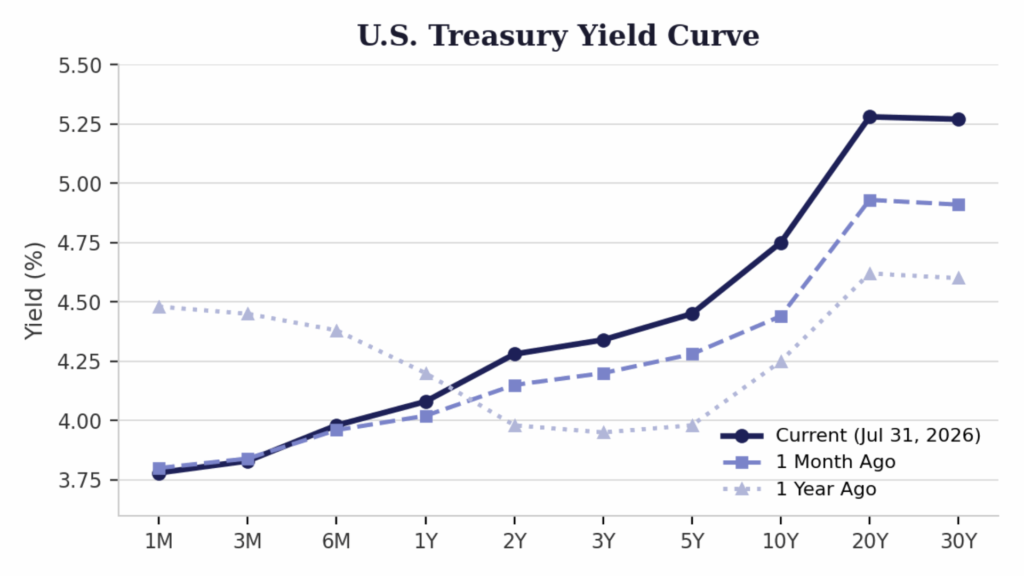
The bond market was where the real drama played out. Yields spiked at the long end of the curve — the 10-, 20-, and 30-year rates jumped 31, 35, and 36 basis points respectively, pushing both the 20- and 30-year above 5.25% and the 10-year to 4.75%. That move hammered long-duration bond funds: the iShares 20+ Year Treasury Bond ETF (TLT) sank 4.5% on the month, while the ultra-short SPDR 1-3 Month T-Bill ETF (BIL) actually eked out a 0.3% gain. The front end stayed anchored near the Fed’s 3.50%-3.75% target — the FOMC held for a fifth straight meeting on July 29 — but the long end was sending a louder message about inflation and supply, and the curve steepened sharply as a result.
Macro & Commodity Update
The labor market kept cooling. June nonfarm payrolls came in at just 57,000, well shy of the ~115,000 consensus, and the unemployment rate actually ticked down to 4.2% — a one-year low — but for the wrong reason, as the labor force participation rate slipped another 0.3 points to 61.5%, a five-year low. On the activity side, though, the economy looked anything but weak: the ISM Manufacturing PMI jumped to 55.6, its highest reading in four years, and retail sales logged a fifth straight monthly gain.
Inflation is the wrinkle. Headline CPI eased to 3.5% year-over-year, snapping a three-month streak of increases, and core inflation cooled to 2.60% — both encouraging on their face. But the Producer Price Index told a different story, holding at an elevated 5.5% year-over-year, its hottest reading since December 2022. With oil surging and pipeline price pressure building, the market’s read is that the disinflation trend may be stalling out.
Commodities were the engine of the whole narrative. Brent crude rocketed 30.3% to $91.82 a barrel and WTI climbed 19.4% to $84.25 as escalating Middle East conflict, blocked shipping lanes, and tighter global supply re-applied pressure — pushing the average price at the pump up 26 cents to $4.23 a gallon. Precious metals were mixed, with gold (GLD) up a modest 0.86% while silver (SLV) gave back 2.1%.
Crypto bounced back from a brutal June. Bitcoin rose 7.7% to about $64,800 and Ethereum surged 19.2% to roughly $1,919, though both remain well off their highs from earlier in the year.
Market Outlook – The Fed Debate Flips Hawkish
The single biggest shift heading into August is in rate expectations. A month ago the debate was about when the Fed would cut; now the CME FedWatch tool puts the odds of a 25-basis-point hike at the September 16 meeting at roughly 64.5%, which would lift the funds rate to 3.75%-4.00% — and markets are increasingly pricing the possibility of additional hikes in the back half of the year. The catalyst is the oil-fueled inflation scare: with Brent up 30% and PPI running at 5.5%, traders are betting the Fed will feel compelled to lean against price pressure even as hiring slows.
That sets up the central tension of the second half — a cooling labor market arguing for patience against re-accelerating commodity and pipeline inflation arguing for tightening. It’s an uncomfortable spot for both the Fed and for long-duration assets, which is exactly why the long end of the curve broke higher and why high-multiple technology stocks were the first to feel it. The mid-August CPI print and the next jobs report will be the swing votes; so, frankly, will the price of oil and the headlines out of the Middle East.
For portfolios, July was a useful reminder that leadership rotates and diversification earns its keep. The energy, financials, and health care trades that worked this month are the mirror image of the mega-cap tech trade that dominated the prior two years, and a market where the baton can pass cleanly is a more durable one — even if the handoff comes with higher yields and a choppier tape.
Bottom line: the growth scare has given way to an inflation-and-rates story, and with the Fed debate now tilting toward a hike, the next leg is likely to reward the cyclicals, value names, and short-duration positioning that actually held up in July.